

Want to know the exact system to scale your business to 7+ figures?
CLICK HERE TO LEARN MORE
Episode Highlights:
- Learn the game-changing ‘Business X-Ray’ method that revealed 80% of Bart’s revenue came from an unexpected source, and how he leveraged this discovery
- Discover the strategic three-part business model that allowed Bart to step away from daily operations and focus on genuine growth
- Understand the science behind the ‘Gold Job’ system that dramatically improved placement ratios and team performance
Episode Summary:
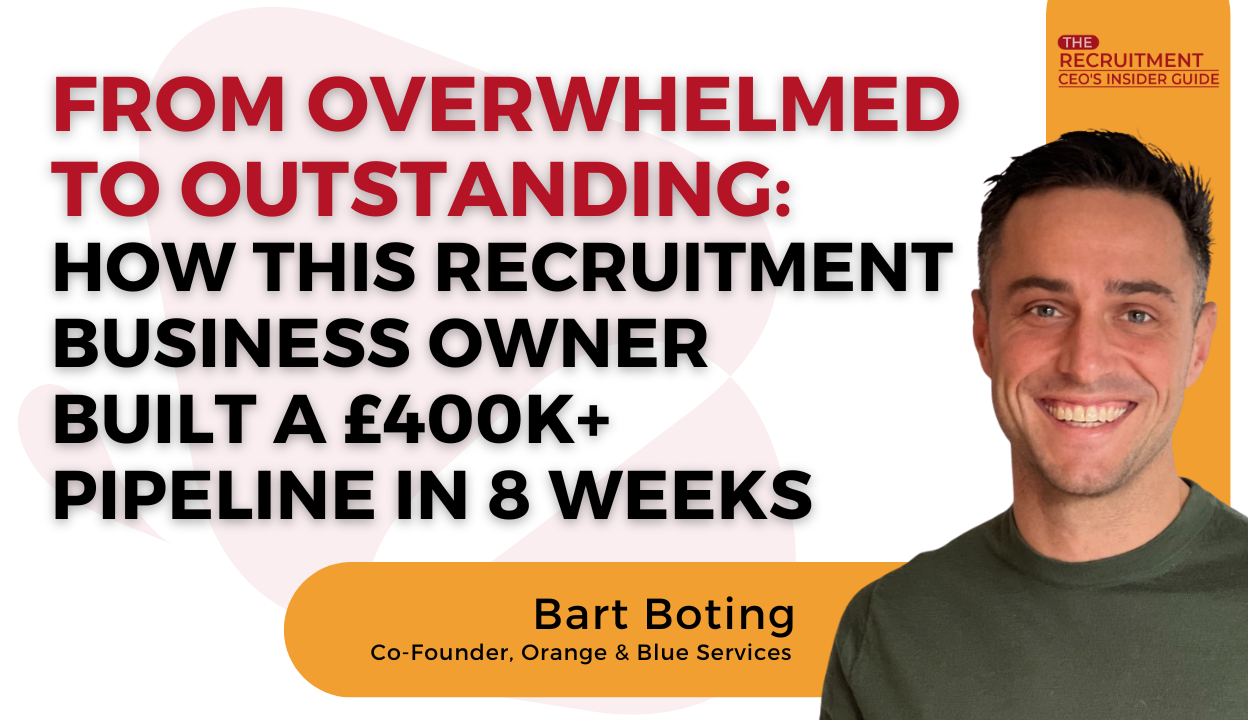
Ever wondered how a manufacturing manager with zero recruitment experience built a thriving 7-figure agency? In this episode, Bart Boting shares his remarkable journey from being an overwhelmed business owner to creating a scalable recruitment operation that generated a £400K-£500K pipeline in just 8 weeks. His story proves that with the right systems and mindset shifts, you can transform your agency whilst gaining back precious family time.
Tune in to this practical, results-focused episode to learn how you can shift from being caught in the daily grind to leading a structured, profitable recruitment business. Whether you’re struggling with time management or looking to scale your agency, Bart’s proven framework offers a clear path forward.
▬▬▬▬▬▬▬▬▬▬▬▬▬▬▬▬▬▬▬▬▬▬▬▬▬▬▬▬▬▬▬▬▬▬▬▬▬▬▬▬

▬▬▬▬▬▬▬▬▬▬▬▬▬▬▬▬▬▬▬▬▬▬▬▬▬▬▬▬▬▬▬▬▬▬▬▬▬▬▬▬
WANT TO CHAT IT OUT?
Let’s have a chat to see IF or HOW this can work for your recruitment or executive search business, apply here and give me some details about your business:
CLICK HERE TO APPLY FOR A PROFIT ACCELERATOR SESSION
▬▬▬▬▬▬▬▬▬▬▬▬▬▬▬▬▬▬▬▬▬▬▬▬▬▬▬▬▬▬▬▬▬▬▬▬▬▬▬▬
Expanded Episode Notes
Building Systems for Scalable Growth
From Sales-Focused to Systems-Driven
After four and a half years of running his recruitment business, Bart Boting reached a critical turning point. Despite achieving strong revenue, he found himself caught in the trap of doing everything himself. Working with virtual assistants helped, but the delegation was purely top-down without allowing team members to think independently or take ownership. This approach, while initially successful, became a bottleneck for growth and left Bart feeling spread thin across all aspects of the business.
The E-Myth Revolution
Reading “The E-Myth” by Michael Gerber proved to be a pivotal moment for Bart and his business partner. The book’s principles aligned perfectly with their growing recognition that to scale effectively, they needed to move beyond the traditional recruitment model where one person handles everything. This revelation, combined with their coaching programme, helped them understand that building robust systems wasn’t just about delegating tasks – it was about creating a framework where team members could thrive independently.
Implementing Structured Delegation
Moving away from the ‘chief of everything’ role required a complete mindset shift in how tasks were delegated. Instead of simply handing down assignments, Bart developed systems that empowered team members to think and act independently within their roles. This new approach to delegation meant creating clear processes, establishing proper handover points between team members, and setting up accountability measures that didn’t require constant oversight.
Creating Repeatable Processes
By focusing on systemisation, Bart transformed his business operations from reactive to proactive. Each core business function was broken down into repeatable processes, making it easier to train new team members and maintain consistent quality. This systematic approach meant that success no longer depended solely on individual talent or effort – it became embedded in the business’s operational DNA, allowing for sustainable growth without requiring Bart’s direct involvement in every aspect of the business.
Optimising the Recruitment Process Structure
Recruitment Sourcing Excellence
Breaking down the recruitment process revealed that sourcing required a distinct skill set and focused attention. Bart Boting restructured this crucial first stage to include dedicated sourcers who could concentrate solely on finding and preparing candidates. This role demanded high attention to detail, strong organisational skills, and the ability to thoroughly screen candidates before moving them forward. By having specialists in this position, the quality of candidates improved significantly, and the team could maintain a consistent pipeline of qualified professionals.
Strategic Account Management
Account management emerged as the vital bridge between sourcing and sales, requiring its own dedicated focus and expertise. This role centred on building and maintaining strong client relationships while ensuring smooth candidate placements. Account managers took ownership of guiding both temporary and permanent workers through the placement process, maintaining regular client contact, and managing ongoing relationships. By separating this function, Bart’s team could provide more attentive service to existing clients while ensuring placed candidates received proper support throughout their journey.
Targeted Sales and Business Development
The sales hunting component became a specialist function focused purely on new business acquisition and fee negotiation. Rather than trying to find generalists who could handle everything, Bart identified that successful hunters needed to be fast-paced, bonus-driven professionals who excelled at building new relationships quickly. This role concentrated on strategic networking, pursuing qualified opportunities, and securing better fee arrangements – tasks that required a completely different mindset from sourcing or account management.
Building Agile Teams
In implementing this three-part structure, Bart paired recruiters with account managers to form small, agile teams. This partnership approach allowed each specialist to focus on their strengths while maintaining clear communication channels. The account managers could concentrate on client relationships and placements, while recruiters focused purely on sourcing and candidate assessment. This team structure proved more effective than the traditional 360-degree recruitment model where one person attempts to handle all aspects of the process.
Strategic Lead Qualification and Job Prioritisation
Developing a Robust Conversion System
Bart Boting revolutionised his approach to lead qualification by implementing a structured conversion system. Moving beyond the simple notion that ‘a lead is a lead’, he established specific criteria that determined the true value and potential of each opportunity. This systematic approach helped identify which roles would yield the highest return on time investment, considering factors such as how long positions had been open, the level of client engagement, and the potential for ongoing business relationships.
The Gold Job System
A cornerstone of Bart’s refined business strategy became the ‘gold job’ qualification system. This framework established clear, non-negotiable criteria that every role needed to meet before the team would commit resources to it. Key qualifications included ensuring positions were newly created rather than long-standing vacancies, securing exclusive or limited-agency arrangements, and confirming direct access to hiring managers rather than going through intermediary systems. This structured approach empowered team members to make confident decisions about which opportunities to pursue.
Strategic Business Selection
Perhaps the most challenging yet transformative aspect of the new qualification system was learning to decline opportunities that didn’t meet the established criteria. In one notable instance, Bart walked away from what appeared to be a promising opportunity – despite meeting the business owner and seeing potential – because it failed to meet their strategic criteria. This disciplined approach to selection, while initially feeling counterintuitive, proved crucial in maintaining focus and ensuring resources were directed towards the most valuable opportunities.
Maximising Team Efficiency
By implementing these qualification systems, the entire team gained clarity on where to focus their efforts. Everyone understood what constituted a ‘gold job’, eliminating confusion and reducing time spent on less valuable opportunities. This shared understanding meant that when turning down work that didn’t meet their criteria, the team could confidently focus on pursuing opportunities that would yield better results, knowing they were saying ‘yes’ to more valuable prospects by saying ‘no’ to less suitable ones.
Leveraging Relationship Capital for Business Growth
Power of Referral Networks
Through implementing the business X-ray process, Bart Boting made a crucial discovery – approximately 70-80% of his revenue stemmed from referral relationships. This revelation challenged his initial assumption about the importance of cold outreach and new business development. Rather than constantly pursuing new connections, the data clearly showed that nurturing existing relationships and maximising referral opportunities provided the most substantial return on investment. This insight fundamentally shifted how Bart approached business development.
Systematising Warm Outreach
Armed with this understanding, Bart developed a systematic approach to warm network engagement. He created a comprehensive list of 80-100 contacts from his previous manufacturing career and current business relationships, people who already knew and trusted him. Rather than viewing warm outreach as something that couldn’t be systematised, Bart worked with his virtual assistant to create a structured process for regular, meaningful contact with these valuable connections. This systematic approach generated a pipeline worth £400-500K within just eight weeks.
Deepening Existing Relationships
Instead of spreading resources thin across numerous surface-level connections, Bart focused on deepening relationships with key decision-makers who had already demonstrated trust and loyalty. This involved understanding each contact’s specific needs, challenges, and communication preferences. By maintaining regular, meaningful contact through a structured follow-up system executed every three months, these relationships continued to flourish without requiring constant personal attention from Bart himself.
Strategic Relationship Management
The focus shifted from quantity to quality in relationship building, with particular attention paid to production managers and HR representatives who had previously generated successful placements. This targeted approach meant investing time and resources where they would yield the greatest returns, rather than trying to maintain superficial connections across a broader network. By documenting and analysing these successful relationships, patterns emerged that helped inform future business development strategies.
Applying the Pareto Principle to Business Growth
Business X-Ray Analytics
The transformative journey began when Bart Boting undertook a comprehensive analysis of his business data, examining several years of revenue and placement information. Though time-intensive, requiring nearly two full days to compile and analyse the data, this deep dive proved invaluable. The business X-ray process revealed clear patterns about which clients, roles, and activities generated the highest returns. By meticulously tracking every placement and revenue stream, Bart uncovered that 80% of his business success came from just 20% of his client base.
Identifying High-Value Client Characteristics
Moving beyond simple revenue figures, Bart analysed the common characteristics among his most profitable clients. This involved examining factors such as decision-making processes, communication styles, industry sectors, and company cultures. The analysis revealed specific patterns in terms of company size, management structure, and recruitment needs that consistently appeared among the top-performing client relationships. This detailed profiling helped establish a clear picture of what made certain clients more valuable than others.
Creating the Ideal Client Avatar
From the data analysis emerged a detailed profile of the ideal client – one who not only generated significant revenue but also aligned with the business’s strengths and values. This profile went beyond basic demographics to understand fundamental aspects like their pain points, daily challenges, and what motivated their hiring decisions. By understanding what kept these ideal clients ‘up at night’, Bart could better position his services to address their specific needs and concerns.
Implementing Data-Driven Marketing
Armed with this detailed understanding of ideal clients, Bart refined his marketing and outreach strategies to specifically target similar organisations. Rather than casting a wide net, he focused resources on reaching decision-makers who matched the profile of his most successful client relationships. This targeted approach meant marketing efforts became more efficient and effective, speaking directly to the concerns and needs of prospects most likely to become valuable, long-term clients.