

Want to know the exact system to scale your business to 7+ figures?
CLICK HERE TO LEARN MORE
Episode Highlights:
- Understand why LinkedIn’s monopoly is hurting your recruitment business and putting you at risk.
- Learn 5 powerful strategies to transform your CRM from a simple storage tool into a dynamic placement machine.
- Discover how automated nurture sequences can keep candidates engaged—even when they’re not actively looking.
Episode Summary:
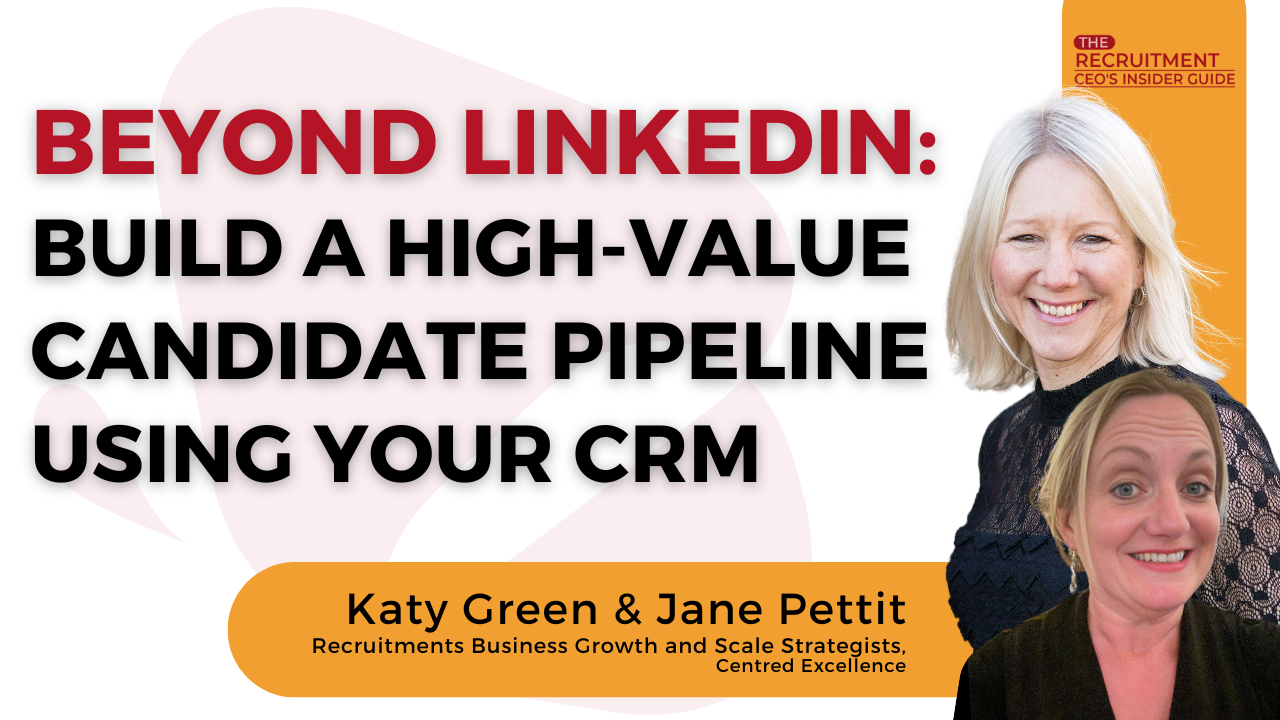
For years, recruiters have relied on LinkedIn to find top talent, but what happens when the rules change? In this episode, Katy Green and Jane Pettit uncover why LinkedIn is limiting your ability to build a sustainable, high-quality candidate pipeline—and why it’s time to shift your strategy. If you’re tired of rising costs, declining response rates, and ever-changing algorithms, this conversation will help you take back control. Discover how to turn your CRM into a revenue-generating asset that keeps you ahead of the competition.
Don’t let LinkedIn control your business!
If LinkedIn disappeared tomorrow, would your candidate pipeline survive? Tune in to this must-listen episode to future-proof your recruitment strategy and build a database that works for you—not against you. Click play now and take the first step towards a more profitable, sustainable business.
Resource Mentioned:
▬▬▬▬▬▬▬▬▬▬▬▬▬▬▬▬▬▬▬▬▬▬▬▬▬▬▬▬▬▬▬▬▬▬▬▬▬

▬▬▬▬▬▬▬▬▬▬▬▬▬▬▬▬▬▬▬▬▬▬▬▬▬▬▬▬▬▬▬▬▬▬▬▬▬▬▬▬
WANT TO CHAT IT OUT?
Let’s have a chat to see IF or HOW this can work for your recruitment or executive search business, apply here and give me some details about your business:
CLICK HERE TO APPLY FOR A PROFIT ACCELERATOR SESSION
▬▬▬▬▬▬▬▬▬▬▬▬▬▬▬▬▬▬▬▬▬▬▬▬▬▬▬▬▬▬▬▬▬▬▬▬▬▬▬▬
Expanded Episode Notes
Taking Back Control: Why Your CRM, Not LinkedIn, Is the Real Asset in Your Recruitment Business
For the modern recruitment business, the tools you rely on can make or break everything from candidate flow to client satisfaction—and, ultimately, the growth and resilience of your firm. In this frank, practical episode of Recruitment CEO, Katy and Jane confront the uncomfortable truth about LinkedIn’s tightening grip on recruitment, and share why your CRM deserves to be at the centre of your candidate and client strategies, not collecting digital dust in the background.
Drawing from hard-won experience and years working with high-performing agencies, Katy and Jane break down what’s going on, what it means for you, and, most importantly, the straightforward actions you can take to turn your CRM into a revenue-generating asset that protects your business, even in uncertain times.
The LinkedIn Dependency Problem: How Your Candidate Pipeline Became Someone Else’s Asset
For years, LinkedIn has been the default answer to candidate sourcing. As Jane recalls, it revolutionised the industry—suddenly, there was no more cold calling company receptionists or hunting through directories. Everyone you needed to know in your market seemed findable at the click of a button. But with that convenience, a dangerous dependency has crept in. Katy lays it out clearly: recruitment businesses—many of them, perhaps even your own—are now so dependent on LinkedIn that they’re exposed to risks outside of their control.
Costs for premium accounts and recruiter licences are rising rapidly, yet actual response rates from candidates are plummeting. Candidates are swamped with InMails from every direction, meaning your message is more likely to be lost in the crowd than ever before. On top of this, LinkedIn’s shifting algorithms make it harder to reach your target market unless you’re willing to crank up your ad spend even further.
Jane puts it into perspective: if LinkedIn is the only answer your team gives when asked where candidates come from, you don’t control your own business pipeline anymore. Katy likens this dependency to being told by your gas supplier that prices are going up, but knowing you can’t simply walk away. When LinkedIn controls cost, access, and even the very data on your contacts, the risk is clear: if your account is suspended, restricted, or even blacklisted, your entire pipeline can vanish overnight.
Worse still, the “monopoly” effect means the very same candidates are being approached by every other recruiter—and by direct employers to boot. It’s a race to the bottom based on who’s willing to spend more on ads, not on who’s built the best relationships or has the deepest expertise. LinkedIn starts looking less like a tool and more like an expensive, increasingly ineffective job board—one that everyone can access, diminishing any competitive edge you once had.
From Storage Cupboard to Goldmine: Rethinking How You Use Your CRM
If you’re relying on LinkedIn as your primary, or only, source of talent, Katy and Jane are clear: you’re running your business on a foundation you do not own. The alternative? A CRM that isn’t just a passive storage unit for candidate data, but a living, breathing marketplace that actively delivers placements, revenue, and long-term business value.
Most recruitment leaders know there’s untapped gold in their CRM, but very few treat it as the heartbeat of their business. Katy shares the story of how, at Aspire, they actually named their CRM “Archie” to make it more personal, reminding the entire team of the value to be nurtured rather than neglected. The result? Archie became their highest-performing source of candidates and placements.
The challenge for most businesses is that their CRMs have become bloated, messy, and unloved—stacked with outdated contact records and patchy tagging. Jane notes the familiar sense of overwhelm this creates, and the inertia it breeds: “Our CRM’s a mess, loads of consultants have come and gone, no one tagged anything, and fixing it feels impossible.” But, as she highlights, you’ve got two practical choices—declare a fresh start from today and do it right moving forward, or invest in a short, intensive clean-up project. Whether you hire a student for data entry or use offshore admins, the cost is trivial compared to pouring another year’s budget into underperforming LinkedIn licences.
Once your CRM data is clear and searchable, you unlock the ability to tag and segment by skills, sector, seniority, and status—making intuitive searches possible and ensuring your team can actually find the right people at the right time. From there, it’s about regular, proactive nurture: follow-ups, categorisation, and updates, so candidates aren’t just sitting in digital limbo until a job comes up.
Making Your CRM Do the Heavy Lifting: Automation Without Losing the Human Touch
Ask most recruiters about “automating candidate nurture,” and there’s a risk their eyes glaze over, thinking it’s all about clever tech. Jane makes it clear that true automation starts with process and accountability—even if that’s just a designated person phoning through the database every month. Who on your team is responsible for reaching out to dormant or passive candidates—even before you have a job to tempt them with?
The basics matter most. Monthly job alerts, personal updates, and even a simple systemised email sequence to check in with candidates can keep you in their world far more effectively than another generic InMail on LinkedIn. Jane’s approach is practical: map out the first step (for example, a three-touchpoint follow-up sequence for every new registrant), break it down, and just get it done. Most recruiters are already spinning up this sort of content in an ad hoc way—what’s missing is the system and the consistency.
Jane and Katy are strong believers that human contact can’t be entirely replaced by tech—phone calls matter; relationship matters. But technology is there to back you up, acting as a prompt, a nudge, and a way of showing up in your candidates’ inboxes or via SMS/WhatsApp even when they’re not taking your calls. After all, the candidate you didn’t place last month is your future placement—or future client. As Jane puts it, “candidates are our lifeblood.” The more consistent and structured your nurture process, the closer you’ll get to having talent at your fingertips, ready to match to jobs in real time rather than starting from zero with each new vacancy.
Monetising Your Database: Turning Your CRM into a Revenue Engine
Far too many recruitment businesses treat their CRM as a basic admin tool, rather than a genuine business asset. Katy and Jane challenge you to think differently: your CRM isn’t just for storing data—it holds enormous, often unrecognised, value.
First, there’s the direct monetary value: a clean, engaged database adds value to your business, both in ongoing revenue and in eventual sale price, should you ever look to exit. Prospective buyers want to know you have proprietary, accessible, and valuable candidate and client relationships—not just a few LinkedIn connections.
But the possibilities run much deeper than that. Your CRM, if managed well, allows all sorts of revenue-generating activities. Jane highlights referral programmes that keep ex-candidates warm and active, turning past placements into sources of new introductions. Post-placement follow-ups—six months, one year, whenever your CRM pings you—aren’t about poaching but about nurturing loyalty, building future business, and uncovering opportunities for both repeat placements and new vacancies created from leavers.
Even candidates you didn’t place can be nurtured via specific email sequences, offering them value and making it far more likely they’ll come back into your pipeline when the timing is right. The CRM becomes the “restaurant” (as Jane calls it) where the value is delivered, while LinkedIn is just the queue out the front. You only truly “own” the candidates once they’re in your CRM and you’re actively building ongoing relationships.
Katy and Jane push the thinking forward: with well-curated talent pools inside your CRM, it’s even possible to monetise access to pre-screened candidates—effectively productising your IP for clients willing to pay to see or access your top talent. While this won’t suit every agency or model, it shows what’s possible when you start treating your data as a business asset, not just an administrative chore.
Building Authority and Community—Standing Out Beyond LinkedIn
Once you’re actively using and nurturing your database, a new advantage emerges: industry authority. Your CRM, with its wealth of up-to-date, tagged information on salaries, skills, and market movements, gives you all you need to produce data-backed reports and insights for clients. Whether as part of your ordinary service or as a value-added product, you can deliver intelligence that builds trust and positions you firmly as a sector specialist—not just another CV sender.
Rather than being just “another recruiter with a LinkedIn licence,” you become the consultant, the adviser, the go-to partner who can warn of salary trends, hiring bottlenecks, or shifting candidate behaviour. When you automate regular delivery of this information—whether as a report, invite-only webinar, or community update—you differentiate your business and build long-term loyalty both with candidates and clients.
This leads naturally into building a genuine community around your database. Jane describes how some firms are using their CRMs to host closed groups, alumni events, or monthly coaching sessions for candidates—supporting them in their careers and keeping the agency top of mind. Whether you run in-person meet-ups, webinars, or simple regular email bulletins, the principle is simple: offer more than just jobs. In doing so, you create advocates for your brand, deepen engagement, and ensure your business is always front of mind when the market turns again.
Choosing (and Using) the Right CRM: Simplicity and Consistency Win
Faced with a bewildering market of CRM options, it’s easy to be distracted by systems that promise to “do everything.” Jane’s advice is grounded and straight to the point: go for a CRM you and your team will actually use. You want simple tagging and segmentation, the ability to do automated email and SMS sequences, and a prompting system that nudges follow-up rather than swamping you in overdue tasks.
If you make the CRM clunky or complex, consultants simply won’t use it and you’re back to square one. The aim is to embed regular use into the daily rhythm of the team, aided by prompts and sensible workflows, not to drown people in features. It’s about knowing which tasks can be automated, who’s responsible for what kind of follow-up, and making it as easy as possible to stay on top of the data.
Stop tolerating “we only call when we’ve got a job”—use your CRM to systemise and track every touchpoint, for every candidate and every client, from registration to placement and beyond. You’re not aiming for perfection overnight; start with one or two foundational automations or sequences, and build from there. As Jane and Katy stress, even a few well-run processes can provide immense lift compared to doing everything on LinkedIn or in a cluttered spreadsheet.
Missed the episode? Be sure to subscribe, follow, and reach out for practical resources, so you can stop relying on luck and start building a recruitment business that’s entirely in your hands.